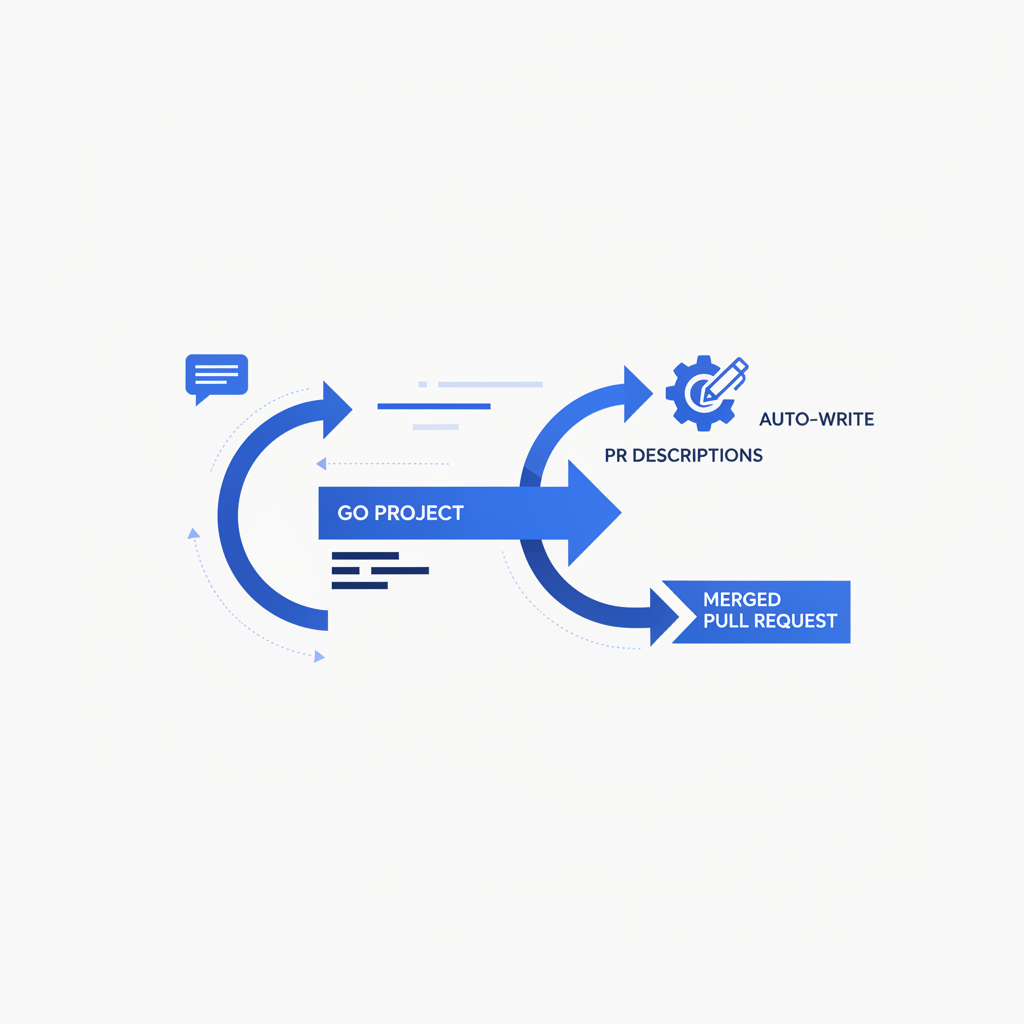
Tutorial: Auto-Writing PR Descriptions for Go Projects
Writing a good Pull Request (PR) description is often an afterthought, a chore squeezed in just before hitting "create PR." Yet, it's one of the most critical pieces of documentation for your codebase. A well-crafted PR description doesn't just explain what you changed; it explains why, outlines how to test it, and highlights potential risks. This context is invaluable for reviewers, future maintainers, and even your future self.
For Go projects, where explicit error handling, strict typing, and clear interfaces are paramount, a precise PR description can significantly speed up reviews and prevent subtle bugs from slipping into production. But let's be honest: manually writing these comprehensive summaries, test plans, and risk assessments for every PR is tedious and time-consuming.
This is where Pullscribe comes in. It's a SaaS tool designed to auto-write PR descriptions by analyzing your diff. This tutorial will walk you through how to leverage Pullscribe effectively for your Go projects, focusing on practical considerations, Go-specific examples, and common pitfalls.
Why Detailed PR Descriptions Matter for Go
Go's design philosophy emphasizes simplicity and clarity. This often translates into code that's easy to read and understand, but it doesn't absolve us from explaining the intent behind changes. Consider these Go-specific scenarios where a good PR description is a lifesaver:
- Interface Changes: Modifying an interface can have ripple effects across an entire codebase. A description that details the impact and migration path is crucial.
- Error Handling Refinements: Go's explicit error handling means changes to error types or propagation logic need careful explanation to ensure correct behavior downstream.
- Concurrency Updates: Introducing or modifying
goroutinesandchannelsrequires a clear explanation of the new concurrency model, potential race conditions, and how they're mitigated or tested. - Dependency Management (
go.mod): Updating module versions can introduce breaking changes or security vulnerabilities. A description that flags these helps reviewers focus on the right areas. - Performance Optimizations: Explaining the benchmarks and reasoning behind a performance tweak helps reviewers validate the approach and ensures the change isn't premature.
Without a detailed description, reviewers might miss critical context, leading to slower review cycles, more back-and-forth, or worse, merging code with unintended consequences.
How Pullscribe Works: The Core Idea
Pullscribe's fundamental job is to analyze the git diff of your current branch against its base (e.g., main or develop) and generate a structured PR description. It aims to provide:
- A concise summary: What problem does this PR solve, and how?
- A detailed test plan: How can reviewers or automated systems verify the changes?
- Identified risks: What are the potential downsides, breaking changes, or areas of concern?
It does this by leveraging AI to understand the semantic meaning of your code changes, rather than just presenting a raw list of modified lines. For Go, this means it can often infer the purpose of changes to structs, interfaces, function signatures, and error handling patterns.
Setting Up Pullscribe for Your Go Project
Pullscribe integrates into your existing Git workflow. The primary input it needs is your diff. While the exact integration might vary (e.g., a CI/CD step, a local CLI tool), the core principle remains the same: feed it the diff.
Let's consider a common scenario: you're working on a feature branch, and you want Pullscribe to generate a description before you open the PR.
Concrete Example 1: Generating a Diff for Pullscribe
Imagine you're on a branch called feat/new-user-service. Your base branch is main. You'd typically generate the diff like this:
git diff main...HEAD
This command shows the changes between main and your current HEAD (your latest commit on feat/new-user-service), including any commits that are unique to your branch.
You would then pipe this output to Pullscribe. While the exact Pullscribe CLI command or API call isn't detailed here, conceptually it would look something like:
git diff main...HEAD | pullscribe generate --format markdown --project-type go
The --project-type go flag (or an equivalent configuration) is important. It tells Pullscribe to apply Go-specific analysis models, helping it better understand Go idioms, common library usage, and potential implications of changes within the Go ecosystem. This might involve recognizing standard library packages, common error patterns (e.g., errors.Is, fmt.Errorf), and the structure of go.mod files.
Auto-Writing Descriptions: Go-Specific Considerations & Examples
Pullscribe's real power for Go projects comes from its ability to interpret changes in the context of Go's language features and best practices.
Let's look at a common Go change and how Pullscribe might interpret it.
Concrete Example 2: Adding a New Field to a Go Struct
Suppose you have an existing User struct and you need to add a new field, EmailVerified, and update the associated SaveUser function to persist this new state.
Original user.go:
package models

import (
    "time"
)

type User struct {
    ID        string    `json:"id"`
    Name      string    `json:"name"`
    CreatedAt time.Time `json:"created_at"`
}

func SaveUser(user User) error {
    // Simulate saving to a database
    // ... actual database interaction ...
    return nil
}
Modified user.go (your diff):
--- a/models/user.go
+++ b/models/user.go
@@ -7,9 +7,14 @@
 type User struct {
    ID        string    `json:"id"`
    Name      string    `json:"name"`
+   Email     string    `json:"email"`
+   EmailVerified bool   `json:"email_verified"`
    CreatedAt time.Time `json:"created_at"`
 }

 func SaveUser(user User) error {
    // Simulate saving to a database
+   if user.EmailVerified && user.Email == "" {
+       return errors.New("cannot verify email if email address is empty")
+   }
    // ... actual database interaction ...
    return nil
 }
When Pullscribe analyzes this diff, it wouldn't just say "added lines." Instead, with its Go-specific understanding, it could generate something like this:
Pullscribe Generated PR Description
Summary:
This PR introduces an Email field and an