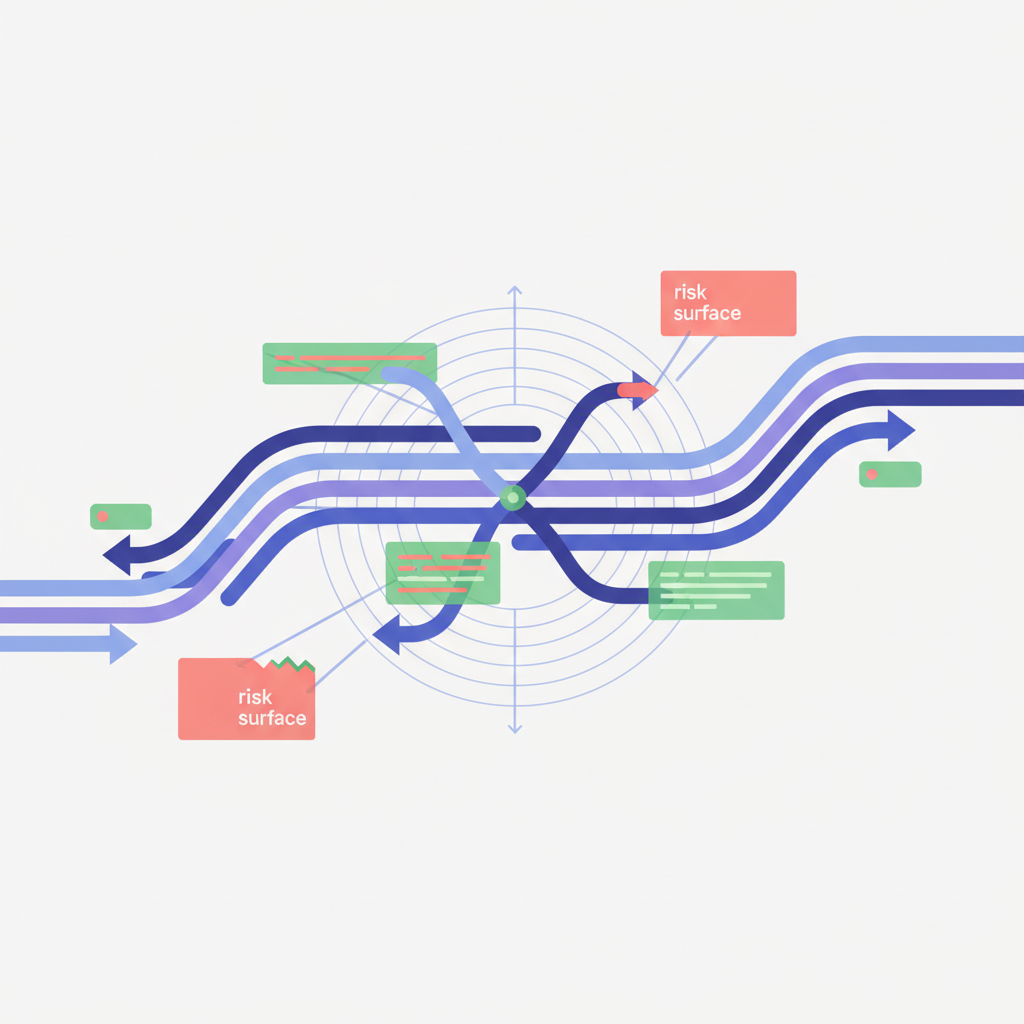
Refactoring PRs: Describing the Risk Surface
Refactoring. The word alone often brings a mix of dread and satisfaction to engineers. On one hand, it's the noble pursuit of cleaner code, improved architecture, and reduced technical debt. On the other, it's the subtle art of changing something without changing anything – a high-wire act where the safety net is your test suite and the audience is your team.
The promise of a refactoring PR is deceptively simple: "No functional changes, just improved structure." This promise, however, often masks a significant risk surface. Unlike feature development, where you're introducing new behavior, or bug fixes, where you're correcting existing behavior, refactoring aims for zero external behavioral change. Yet, it's precisely this expectation of sameness that makes describing potential risks so crucial. When something does break in a refactor, it's often unexpected, subtle, and incredibly hard to trace.
The Nature of Refactoring PRs
At its core, refactoring is about improving the internal structure of code without altering its external behavior. Think of it like renovating a house: you might move walls, re-route plumbing, or update electrical wiring, but from the outside, it still looks like the same house, and ideally, all the appliances still work.
Common refactoring activities include: * Extracting methods or classes to improve modularity. * Renaming variables, methods, or files for clarity. * Changing data structures or algorithms for performance or readability, while maintaining the same API. * Consolidating duplicate code. * Reorganizing module dependencies.
The challenge is that while the intent is to preserve external behavior, the implementation involves significant internal changes. These internal changes touch existing, often battle-tested, code paths. Any subtle misstep can ripple through the system in unexpected ways, leading to regressions that are difficult to debug because the "fix" was supposed to be a non-functional change.
Why Risk Description is Critical for Refactoring
When you submit a refactoring PR, your reviewers are looking for two things: 1. Does it achieve the stated refactoring goal effectively? (Is the code cleaner, more modular, etc.?) 2. Does it introduce any unintended side effects? (Did it break anything?)
Without a clear description of the potential risks, reviewers might not know where to focus their attention. They might assume "no functional change" means "no need for deep scrutiny," which is a dangerous assumption for refactors.
A well-articulated risk surface in your PR description serves several vital purposes:
- For Reviewers: It guides their review. They know which areas to scrutinize for subtle changes in behavior, performance, or resource consumption.
- For Testers: It informs the test plan, helping them design tests that specifically target potential regressions beyond the standard unit tests.
- For Deployers/On-Call: If an issue arises post-deployment, the risk description provides an immediate starting point for investigation, potentially saving hours of debugging. It also helps assess the blast radius and urgency.
- For Future Engineers: It documents the thought process behind the refactor and highlights areas that were considered fragile, offering valuable context for future modifications.
- For Yourself: The act of identifying and articulating risks forces you to think critically about your changes and potentially uncover issues before the PR even leaves your machine.
Ignoring the risk surface is like saying, "I changed the engine, transmission, and brakes, but the car still drives the same, so no need to worry." It's an optimistic, but often naive, approach.
Identifying the Risk Surface
So, how do you identify the risk surface in a refactoring PR? It's about anticipating where unintended consequences are most likely to manifest. Think beyond the immediate functional tests.
Consider these categories when assessing risk:
- Implicit Contracts: Are there parts of the system that rely on internal implementation details that you're changing? Even private methods can be implicitly relied upon by other private methods or test code.
- Performance Characteristics: Does your refactor change the asymptotic complexity of an algorithm, even subtly? Does it alter memory allocation patterns or database query counts?
- Resource Consumption: Could the refactor lead to increased CPU, memory, network I/O, or disk usage? Even if functionally identical, a less efficient implementation could degrade system stability under load.
- Concurrency and Race Conditions: If you're altering shared state or synchronization primitives, the risk of introducing new race conditions or deadlocks skyrockets.
- External System Interactions: Are you changing how your service interacts with databases, caches, message queues, or other microservices? Even a "non-functional" change could affect serialization, deserialization, or network protocols.
- Configuration and Environment: Are there hardcoded values, environment variables, or configuration files that might be implicitly tied to the old structure?
Concrete Example 1: Renaming a Core Service or Module
Let's say you're refactoring a legacy application. You have a monolithic service called LegacyCustomerService and you want to rename it to CustomerManagementService to better reflect its domain and prepare for future decomposition. This seems like a simple rename, right? The code still does the same thing.
Potential Risk Surface:
- API Consumers: Any internal or external API clients (other microservices, frontend applications) that explicitly call
LegacyCustomerServiceor rely on a URL path like/api/legacy-customers. - Configuration Files:
application.properties, Kubernetes manifests, service discovery entries (e.g., Consul, Eureka) that reference the old service name. - Logging & Monitoring: Log aggregation tools (e.g., Splunk, ELK) that filter by service name, metrics dashboards (e.g., Grafana) that query based on
LegacyCustomerServicemetrics. Alerting rules based on the old name. - Deployment Scripts: CI/CD pipelines, Dockerfiles, or deployment scripts that build, deploy, or interact with the service using its old name.
- Downstream Services: Any services that poll or subscribe to events originating from
LegacyCustomerServiceand might have hardcoded the source name.
Describing the Risk in Your PR:
"This PR renames LegacyCustomerService to CustomerManagementService. While the core business logic remains unchanged, this is a wide-reaching change affecting service identity.
Risk Callouts:
* High: Potential for service discovery failures if downstream services (e.g., OrderProcessorService, BillingService) rely on caching LegacyCustomerService's name or if their configuration hasn't been updated in sync.
* Medium: Monitoring dashboards and alerts in Grafana/Prometheus (specifically queries against service_name="LegacyCustomerService") will need updates to reflect the new name; old metrics will cease.
* Medium: Log ingestion filters (e.g., Splunk queries for app=LegacyCustomerService) will stop capturing logs unless updated.
* Low: Minor risk of breaking local developer environments if they rely on specific port mappings or hardcoded service names in their docker-compose.yml that don't auto-resolve.
Mitigation: Coordinated deployment with dependent services and configuration updates. Extensive integration testing targeting inter-service communication."
Strategies for Describing Risk in Your PR
When writing your PR description, be specific and avoid vague statements.
- Specificity over Vagueness: Instead of "May break something," say "Potential for
ServiceAto fail to resolveConfigBdue to a refactored path inConfigLoader, specifically affecting theDATABASE_URLparameter during startup." - Input/Output Changes: Even if the intended output is the same, could the format, order, or timing of data change? Could edge case inputs now behave differently?
- Performance Implications: If you changed an algorithm from O(n) to O(n log n), that's a performance risk under specific load conditions. If you're fetching more data than before, that's a memory/network risk.
- Interaction with Other Systems: Explicitly list which external services, databases, caches, or third-party APIs are most likely to be affected by your refactor.
- Rollback Plan Considerations: Thinking about how you would roll back if things go wrong often highlights the riskiest parts of your change. If a rollback requires a full data migration revert, that's a higher risk than a simple code revert.
Concrete Example 2: Changing a Database Schema or ORM Mapping in a Refactor
Imagine you're refactoring a database interaction layer. You decide to normalize a table, splitting CustomerDetails into Customers and CustomerAddresses, or perhaps you're just updating your ORM (Object-Relational Mapping) to use a new strategy for lazy loading.
Potential Risk Surface:
- Data Migration Errors: If a schema change is involved, the migration script itself could fail, leading to data loss or corruption. Incorrect data type mapping.
- Query Performance Degradation: While the data is now normalized, existing queries might become slower due to new joins or changes in indexing strategy.
- Application-Level Data Parsing Issues: Code that previously expected a flat structure might now receive nested objects, leading to deserialization errors.
- Transactionality: If the refactor changes how multiple database operations are grouped, existing transaction guarantees might be broken or new race conditions introduced.