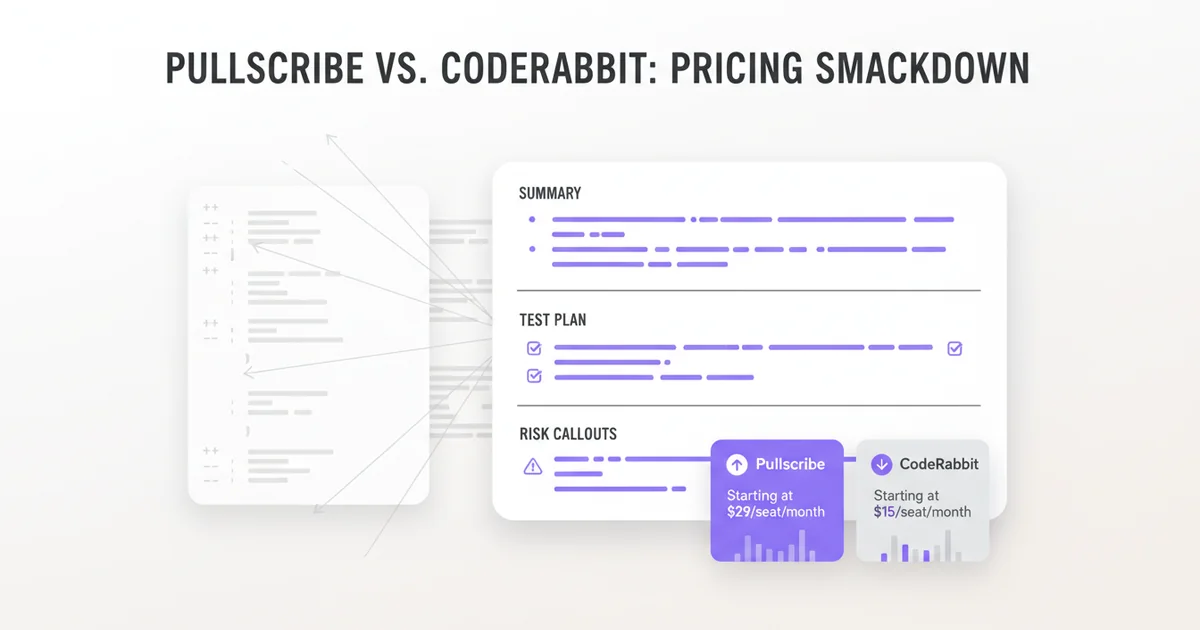
Pullscribe Pricing vs. CodeRabbit: A Practical Comparison for Engineers
Let's be honest: writing pull request descriptions is often a chore. You've just spent hours, days, or even weeks wrestling with code, and now you're expected to context-switch and write a concise summary, detail a test plan, and call out potential risks. It's a critical step for good collaboration, but it's also a significant drag on developer productivity. This is where AI-powered tools like Pullscribe and CodeRabbit come into play, promising to automate this tedious task.
But as engineers, we're not just looking for a solution; we're looking for the right solution, one that fits our workflow, integrates cleanly, and, crucially, makes financial sense. This article dives into a practical comparison of Pullscribe's and CodeRabbit's pricing models, helping you understand where each tool provides value and which might be a better fit for your team's specific needs and budget.
Why This Comparison Matters
Both Pullscribe and CodeRabbit leverage AI to streamline aspects of the pull request workflow. However, they approach the problem from different angles, leading to distinct feature sets and, consequently, different pricing structures. Pullscribe focuses laser-like on generating comprehensive pull request descriptions from your diff, complete with summaries, test plans, and risk assessments. CodeRabbit, on the other hand, offers a broader suite of AI-powered code review capabilities, including code suggestions, refactoring advice, and security insights, in addition to PR descriptions.
Our goal here isn't to declare a universal winner, but to equip you with the information needed to make an informed decision based on your team's primary pain points, existing tooling, and budget predictability.
Understanding the Core Offerings
Before we dive into dollars and cents, let's clarify what each tool primarily delivers:
-
Pullscribe: Its core mission is to eliminate the manual effort of writing PR descriptions. You push your code, and Pullscribe analyzes the
git diffto automatically generate a structured description. This typically includes:- A high-level summary of changes.
- Detailed explanations of what was changed and why.
- A suggested test plan tailored to the diff.
- Identification of potential risks or areas for review. This focused approach means it excels at one specific, yet highly impactful, task.
-
CodeRabbit: Positioned as an AI-powered code review assistant, CodeRabbit offers a more expansive feature set. While it can also generate PR descriptions, its primary value proposition extends to:
- Automated code suggestions and fixes.
- Identifying potential bugs, vulnerabilities, and performance issues.
- Refactoring recommendations.
- Enforcing coding standards. It aims to augment the entire code review process, not just the description phase.
This distinction is fundamental. If your primary headache is the sheer time spent crafting PR descriptions, Pullscribe might be a more direct and cost-effective solution. If you're looking for an AI to act as a comprehensive code reviewer across various dimensions, CodeRabbit's broader feature set might justify a different investment.
CodeRabbit's Pricing Model: A Deep Dive
CodeRabbit's pricing typically reflects its broader scope, often utilizing models common to AI services and developer tools. This can include per-user licensing, usage-based billing (e.g., per-review, per-line-of-code reviewed, or based on AI tokens consumed), or a combination thereof.
Let's consider a concrete example of how CodeRabbit's pricing might manifest. Imagine your team consists of 15 developers. CodeRabbit might offer a plan that charges $20 per active user per month. This would mean a predictable base cost of $300 per month. However, many AI-powered review tools also incorporate usage-based components, especially for the deeper AI analysis.
For instance, CodeRabbit might charge an additional fee based on the volume of code processed or the complexity of the AI analysis. Let's say it charges $0.005 per 1,000 AI tokens processed for review comments and PR description generation. If a typical PR in your codebase involves an average diff size that consumes 50,000 tokens for comprehensive analysis, and your team collectively creates 200 PRs in a month, that's an additional cost of:
(200 PRs * 50,000 tokens/PR) / 1,000 tokens * $0.005 = 10,000,000 tokens / 1,000 * $0.005 = 10,000 * $0.005 = $50.00.
This means your total monthly bill could be $300 (users) + $50 (usage) = $350.
Pitfalls and Edge Cases with Usage-Based Models:
- Unpredictability: While the above example is manageable, what happens during a