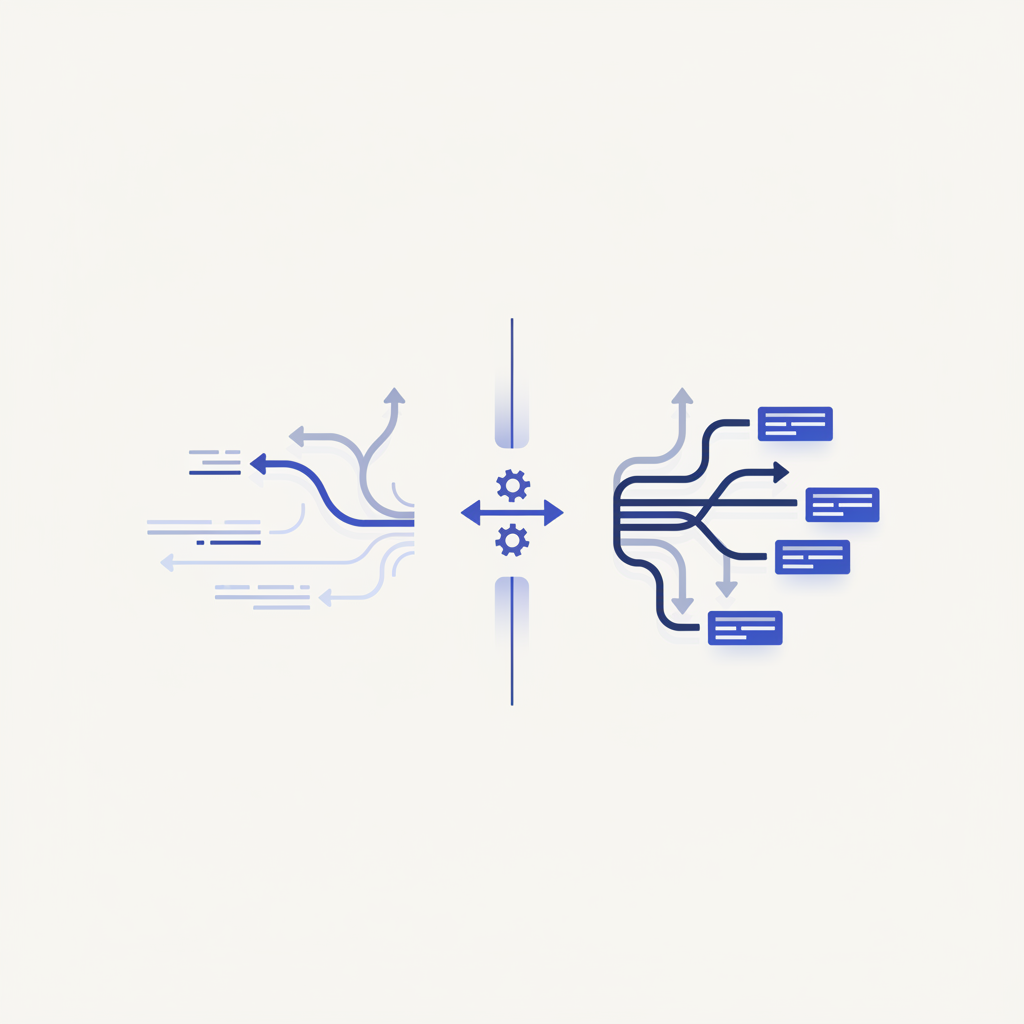
Pullscribe for Startups vs. Enterprise Automation: A Pragmatic Look
Pull requests are the lifeblood of modern software development. They're where code meets collaboration, where changes are scrutinized, and where knowledge is transferred. But let's be honest: writing a good pull request description is often a chore. You've just spent hours, maybe days, deep in the code, solving a problem. The last thing you want to do is context-switch and write prose describing every little detail, summarize the changes, outline a test plan, and anticipate risks.
This is where Pullscribe steps in. It's a SaaS tool designed to auto-write these descriptions directly from your diff, complete with a summary, a proposed test plan, and highlighted risk callouts. The promise is clear: save time, improve consistency, and enhance collaboration.
But does Pullscribe offer the same value proposition to a lean, fast-moving startup as it does to a large, bureaucratic enterprise? While the core benefit of automating PR descriptions remains constant, the emphasis and impact shift significantly. Let's explore how Pullscribe serves these two distinct environments, weighing the benefits against potential pitfalls in each.
The Universal Pain: Crafting Effective PR Descriptions
Before diving into specifics, let's acknowledge the shared problem Pullscribe addresses. Regardless of company size, a well-crafted PR description is crucial for:
- Faster Reviews: Reviewers can quickly grasp the "what" and "why" without digging through every line of code. This reduces cognitive load and speeds up the review process.
- Improved Context: It provides essential background for anyone looking at the code months or years down the line, serving as a mini-documentation for changes.
- Better Testing: A clear test plan guides reviewers (and automated systems) on how to validate the changes effectively.
- Risk Mitigation: Explicitly calling out potential risks encourages proactive discussion and prevents unexpected regressions or security vulnerabilities.
- Knowledge Transfer: It's a critical tool for onboarding new team members or cross-pollinating knowledge between teams.
The challenge is that achieving this level of detail and consistency manually is time-consuming and often neglected, especially under pressure. Engineers are incentivized to ship code, not write essays. Pullscribe aims to bridge this gap, but how its value manifests differs.
Pullscribe for Startups: Accelerating Iteration and Knowledge Transfer
Startups thrive on speed, agility, and resourcefulness. Every engineer wears multiple hats, and time is the most precious commodity.
Key Benefits for Startups:
- Maximized Engineering Time: In a small team, a developer might be responsible for backend, frontend, and even deployment. Automating PR descriptions frees up valuable hours that can be reinvested directly into coding, product development, or customer interaction. Instead of spending 30 minutes crafting a PR, you approve a Pullscribe draft in 5.
- Instant Documentation: Early-stage documentation is often sparse or non-existent. PRs become a vital, organic source of truth. Pullscribe ensures that even in the rush, a coherent record of changes, their purpose, and their impact is created. This is invaluable when the team grows or context is lost.
- Consistent Communication (Even with a Small Team): While a small team might informally communicate changes, relying on memory isn't scalable. Pullscribe instills a consistent structure for PRs from day one, setting a good precedent for future growth and ensuring clarity for every change.
- Smoother Onboarding: As a startup scales, new hires need to get up to speed quickly. A history of well-documented PRs, automatically generated and consistently formatted, provides a powerful learning resource for understanding the codebase's evolution and rationale.
Concrete Example for Startups:
Imagine you're the sole backend engineer at a budding SaaS startup, rapidly building out a new API. You've just implemented a new feature that allows users to update their profiles, involving a new PATCH /users/{id} endpoint in your Go service using the Gin framework. You push your feature/user-profile-edits branch.
Pullscribe analyzes your diff, detects the new endpoint, identifies the fields being updated, and generates a PR description like this:
**Summary:**
This PR introduces the functionality for users to update their profile information via a new API endpoint. It adds a `PATCH /users/{id}` endpoint to the user service, allowing partial updates to user details like `name`, `email`, and `bio`. Data validation has been implemented for incoming fields.

**Test Plan:**
- [ ] Send a `PATCH` request to `/users/{id}` with a valid `name` and `email`. Verify the user's profile is updated correctly.
- [ ] Send a `PATCH` request with an invalid email format. Verify a `400 Bad Request` is returned.
- [ ] Attempt to update a non-existent user ID. Verify a `404 Not Found` is returned.
- [ ] Ensure only allowed fields (`name`, `email`, `bio`) can be updated, and sensitive fields (e.g., `password`) are not modifiable via this endpoint.

**Risk Callouts:**
- Potential for unintended data exposure if validation is not robust for all fields.
- Backward compatibility: Existing clients should not be affected as this is a new endpoint.
This saves you 15-20 minutes, allowing you to jump straight into building the frontend component or tackling the next urgent task.
Pitfalls for Startups:
- Over-Reliance on AI: While excellent, AI isn't perfect. Startups, with their fast pace, might be tempted to blindly accept generated descriptions without review. This can lead to misleading or incomplete PRs if the diff is complex or the AI misinterprets intent.
- **Less Detailed Diff = Less Detailed